So, February 29, Leap Day, seems an appropriate time to start garden blogging for 2012. In a typical year we would have been rushing to start our seeds a week or two ago. My dining room window seat should be covered in soil filled seed cups by now. This year a different project has sprouted itself and consumed our time and energy... a project that has been put off for way too long... an icky not fun project.
Think cobwebs, dead rodents, musty dusty air, and piles and piles of stuff. Yes, that would be our basement. We've had our place almost 8 years and the basement has been our catch all place for misc. building materials, firewood, tons of paint cans, empty jars, used pots, cleaning supplies, old tires, old glass window panes, old doors, ladders, and the old heating oil tank, etc. Oh, and my laundry area too. Well, the time had come to clean it up, paint it and organize it. It also should be noted that half our basement has a concrete floor, the other half is a dirt floor (hence musty smell).
Well without going into great detail because this blog is about gardening, we spent a week clearing out the basement, did two dump runs, put a bunch of free stuff out by the curb (most of it is gone now- yay!), put down a vapor barrier and a plywood floor over the dirt part, and painted the walls a fresh bright white. My hope is to complete the plywood floor space and move all the stuff we're keeping into that room, so we can finish painting the concrete floored space. Then... we can see how best to utilize the basement.
This is where gardening ideas comes in... neatly organized supplies for seed starting, perhaps a grow light system, so I don't have to use my dining room window for starts, shelving to store our crops (root cellar), shelving to store our drinks (wine cellar), and a well-organized workshop space to build misc. garden furniture (potting bench). Also, I want a nice clean pretty laundry center. Is this asking too much?
We'll see what gets done over the next few months.
In other garden news, most of our fall crops wintered over well and we ate a healthy amount of brussel sprouts, turnips, bok choy, and kale. Now, our broccoli are starting to sprout florets, fresh chives and garlic sprouts have been coming up, and our little sprouts of lettuce and mesclun mix that sat there most of the winter is growing again. Also, down at our community garden plot which has a makeshift plastic hoop house over it, we planted some sugar lace snap peas, green onions, and lettuce a few weeks ago and they are all coming up fine.
Thank goodness for Leap Day, for helping me reset my blogging clock. Happy Gardening!
Wednesday, February 29, 2012

Monday, November 14, 2011
Fall Harvest 2011
We were really late in planting our crops for fall harvest, but despite our bad timing, there are a few vegetables that have done really well and along with the young greens we have plenty of fresh veggies to keep us well fed.
Fall harvesting lately has consisted of turnips, potatoes, brussels sprouts, beets, and young chinese cabbage. Our turnips turned out perfect this year. Hardly any root maggots. We've been looking up all sorts of turnip recipes online and so far we have made glazed turnips, added them to chicken soup, and have been eating them thinly sliced in salads. Eaten raw, turnips taste kind of like radishes. We've also been using their greens as a substitute for kale.
In the same bed as the turnips, we planted rutabagas and radishes. The rutabagas did horrible. Some germinated, but were quickly eaten by slugs. None got even close to maturing. Radishes did well but were over-mature and woody before we got around to picking them. So, fall 2011 will be known as the season of the turnips.


This was the first year we grew brussels sprouts. We planted them in the spring and while they are forming sprouts, they are really small and full of aphids. The aphids are a pain to clean off because they hide in the layers. Once cleaned and steamed the sprouts taste really good.

Other crops we have been picking lately are beets and various greens. Our beets are really small, but tasty. The chinese cabbage we planted hasn't quite formed heads yet, but we are eating them as salad greens and using them in stir fry. Kale and bok choy are also staples this time of year. With our fall harvests and our stored veggies (potatoes in the ground) (winter squash and garlic in the basement)(corn, peas, beans in the freezer) we're eating pretty darn well.
This week the weather has definitely gotten colder and we'll see how long everything holds up in the garden.
Friday, October 28, 2011
Saving Seeds
Every spring we love shopping for packets of new seeds at the local nurseries. It's so fun browsing the racks of colorful seed packets and imagining the future delicious meals and beautiful flowers contained in each little seed. We try to grow a few different varieties of vegetables and flowers each year to expand our repertoire. Sometimes, though, we like a variety so much that we want to grow it again the following year. This has led us to the craft of saving seeds.
There are many advantages to collecting your own seeds. Besides saving a little money, you also have an excuse for letting your garden get seedy (which tends to happen when you get overwhelmed and can't keep up with all the harvesting and deadheading). To get started collecting seeds, it helps to plant way more than you can eat (that way you don't feel bad letting some veggies go to seed). Then toward the end of the harvest season, just let some plants go to seed. Let the pod, fruit or seed head mature and then collect the seed. Do some research on the specific vegetable or flower you're trying to collect from because you might find that it's better to just buy the seed especially if it's a hybrid variety.
Here are just a few types of seed we collected this summer.

Sweet Pea Flowers
(Note: the pods are toxic if ingested)

I let the pods dry on the plant. They split open easily to expose the seeds. Be sure the seeds are completely dry before you store them or they will get moldy and rot.

Fava Beans
I also let the pods dry on the plant. A few pods that I didn't collect eventually fell to the grown and are now sprouting into new fava bean plants. If the winter isn't too cold, they baby plants should overwinter and produce beans again next year.

Chives
Chive flowers are a pretty lavender color. Then they dry out and produce tiny black seeds. One seed head produces way more seeds than we need.

I just shake the flower over a piece of paper and then use the paper to funnel the seeds into a bottle.

Label and store the seeds in a dry dark spot like a cabinet.
Don't forget to plant them next year.
If you collect lots of extra seeds you can create your own seed packets which would make cute gifts for your gardening friends.
Monday, October 24, 2011
Growing a Garden: Progress at Orchard & Vine
Over the past month we took on the task of building the last big and highly anticipated feature at the Orchard & Vine Community Garden. The original design I drafted in the May 2010 called for a covered "Garden Pavilion" to serve as a gathering space for potlucks, workshops and meetings and a refuge from the rain and hot sun. We discovered just how important this feature was this past year. Our spring potluck ended abruptly with a passing shower and soggy food and our summer bake sale fundraiser occurred on a hot sunny day with the volunteer hosts hovering in a tiny sliver of shade with platters of melting frosted cupcakes.


With the busy summer growing season over, we set to work on building the Garden Pavilion before the heavy autumn rains. Over the course of several weekends we got the final specs completed, materials approved and purchased, volunteers organized, and got it done. We drafted a simple shed roof design to maximize our limited funds and minimize construction complexity. We couldn't be more pleased with the results.

Breaking tough ground

Anders digging in

Moving the heavy posts

Setting in the posts

Bolting in the beams

Attaching the rafters

Installing the roofing material

Almost done


All done

Ready for a potluck!
Our next goal is to install a gutter and rainwater collection system to allow gardeners to water their plots while the city water is shut off from November to May and to be a model for sustainability. Plus, natural rainwater is better for plants. We're out of construction funds, so we spent this weekend working on our first grant proposal.
Monday, September 26, 2011
Squash & Pumpkin Harvest
This weekend we cleared our squash and pumpkin patch. The leaves had mostly died back, exposing our crop to the mischievous. A neighbor informed us that he had seen a pumpkin of ours smashed to bits a few days prior up the road and suggested we don't delay our harvest. We took a close look and sure enough a good-sized pumpkin as well as two beautiful turban squashes were gone. We weren't sad about the pumpkin, but the turban squash... we were looking forward to eating those. One reason we grow pumpkins is to lure kids into taking those instead of the squash. But, I guess the Turbans are just too irresistible for kids, or maybe even an adult gleaned them to enjoy. We always knew that planting in the parking strip could be a challenge. However, this is year three and the first time we've noticed anything taken without our consent, so I guess we can consider ourselves lucky.
One more note about mischievous kids, our neighbor caught a young boy from across the street and his friend up in her yard rustling through her corn patch. Upon asking them what they were doing, they promptly asked to have some corn. They were denied. Coincidentally, I spotted this same 11-year old boy a couple weeks ago riding his bike very slowly along our squash patch.

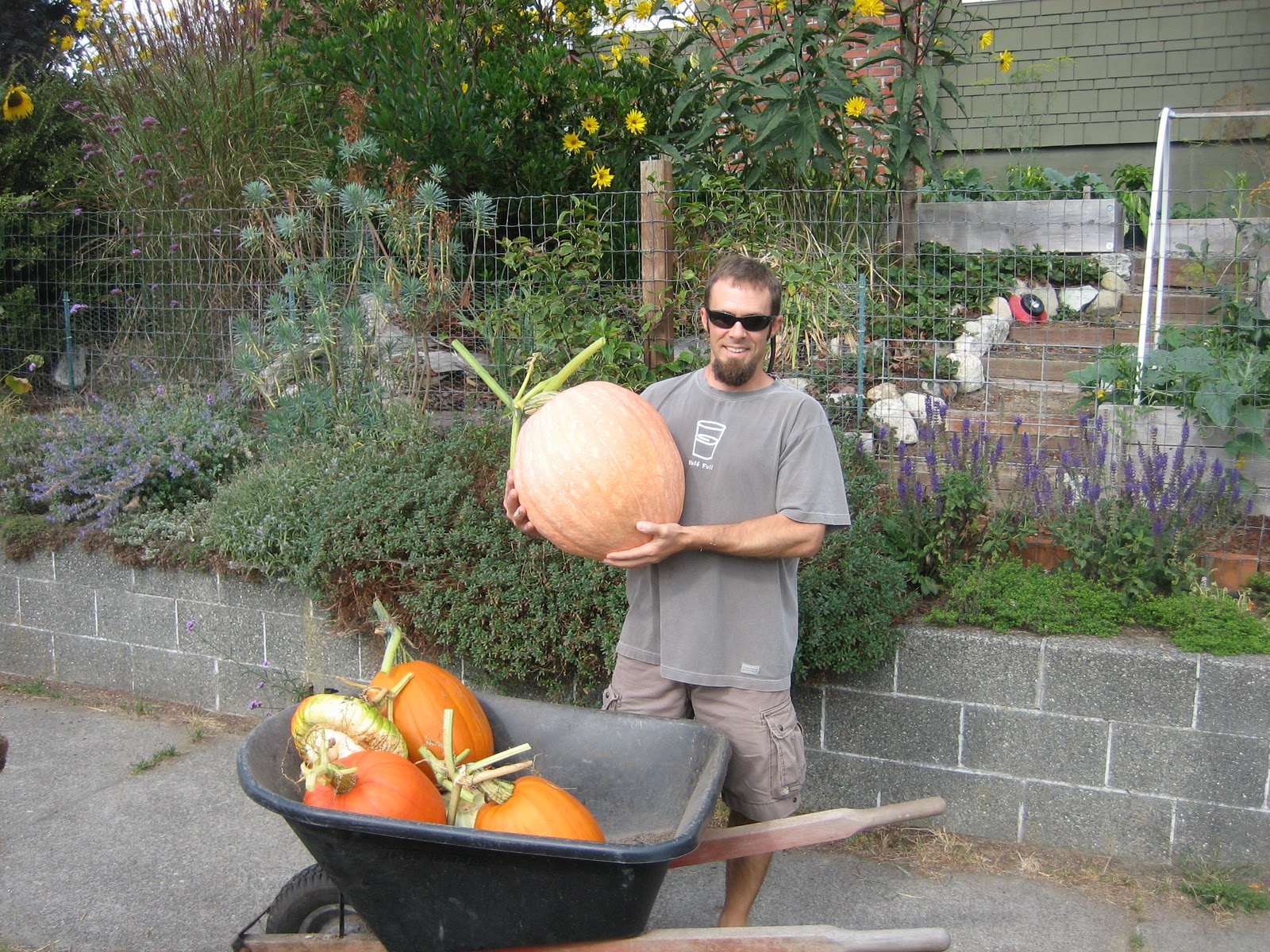
Our big Humpkin
(Hubbard x Giant Pumpkin- we believe)

Final Count for 2011
2- Humpkins
5- Pumpkins (+1 stolen)
8- Buttercup
2- Butternut (+1 we ate)
1- Turban (+1 we ate) (+2 stolen)
While this is the smallest harvest we've had over the past three years, it should be more than plenty to eat over the fall.
Thursday, September 22, 2011
The Bayou Gardener
Terry's favorite Youtube gardener is, Donald, aka webcajun, who has uploaded 112 videos on gardening in Louisiana. These videos transport Terry back home, where the okra and watermelon are bountiful and gardening involves a tractor, sweet tea, a couple dogs, a spacious shop to keep all your equipment, and maybe a gun or two.
Webcajun, like Bunty (see previous post), fills his videos with lots of practical gardening tips, but he also has a number of videos showing how to process your harvest and cook some good ol' Southern food. While some of his advice may not be applicable in our PNW climate, it is fun to see how other gardeners grow according to their conditions.
Check it out.... The Bayou Gardener
(Also, ignore all the weird recent gun posts... his garden posts are much more fun.)
Webcajun, like Bunty (see previous post), fills his videos with lots of practical gardening tips, but he also has a number of videos showing how to process your harvest and cook some good ol' Southern food. While some of his advice may not be applicable in our PNW climate, it is fun to see how other gardeners grow according to their conditions.
Check it out.... The Bayou Gardener
(Also, ignore all the weird recent gun posts... his garden posts are much more fun.)
Monday, September 19, 2011
Inspiring Gardening Videos
If you dreamed of growing an organic year-round edible garden... we found the best series of gardening videos on Youtube this weekend. A british "organic fruit and veg gardening guru", Bunty, created informative videos that cover what she does in her garden for an entire gardening cycle- 18 months. She videotaped in the garden every two weeks or so, so there are thirty-two videos to watch.
We watched a couple of her videos already and can't wait to watch all of them. Unlike most people on youtube, Bunty, is an incredibly well-spoken and experienced gardener. Watching her concisely deliver nuggets of valuable gardening advice while calmly demonstrating proven techniques is so motivating. We've already gleaned some ideas to try out next year. We can learn so much from British gardeners because their climate is similar to ours in the Puget Sound.
Here's a link to the her first video... Bunty's Blog Early January 2010. To see the rest of her videos in order. Click on "Buntysblog" just under the video title and you will be linked to her youtube channel. The list of videos will be on the right side of the screen.
We watched a couple of her videos already and can't wait to watch all of them. Unlike most people on youtube, Bunty, is an incredibly well-spoken and experienced gardener. Watching her concisely deliver nuggets of valuable gardening advice while calmly demonstrating proven techniques is so motivating. We've already gleaned some ideas to try out next year. We can learn so much from British gardeners because their climate is similar to ours in the Puget Sound.
Here's a link to the her first video... Bunty's Blog Early January 2010. To see the rest of her videos in order. Click on "Buntysblog" just under the video title and you will be linked to her youtube channel. The list of videos will be on the right side of the screen.
Subscribe to:
Posts (Atom)


